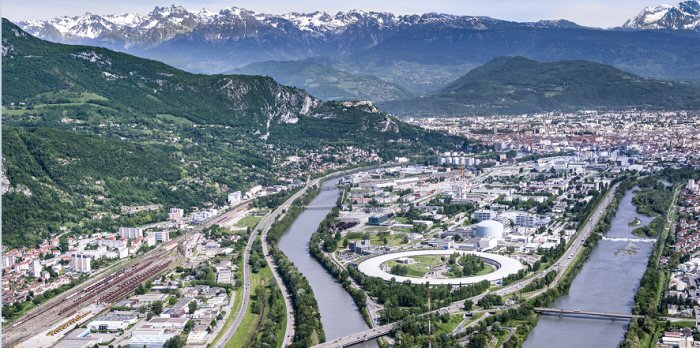
Thesis starting in october 2013, Grenoble. Study of the molecular mechanisms that lead to the formation of protein aggregation nuclei at the surface of materials.
Description
Many proteins interact with material surfaces though non-covalent, reversible adsorption. Under certain conditions protein adsorption can lead to the formation of multimeric aggregates at the surface, which are later released into solution. Insulin is a well-known example of a protein that, in contact with hydrophobic surfaces, aggregates into amyloid fibers (1). We have shown that the entire process of insulin aggregation takes place on the hydrophobic surface, that its aggregation kinetics can be inhibited by the addition of bacterial chaperones (DnaK+DnaJ) and accelerated in the presence of the surface-adsorbed peptides, like LVEALYL. This internal insulin sequence forms the β-sheet core in the insulin amyloid fiber (2). Using a subset of variants of the LVEALYL peptide, we have shown that the stability of the surface-adsorbed peptide and foremost its conformation affects the formation of aggregation nuclei. Indeed, peptides forming stable alpha-sheets when adsorbed on the material, accelerate this process while those adsorbing in alpha-helix conformation delay it (3). In the course of our studies, we have developed biophysical methods (AFM, ATR-FTIR, SPRi, fluorescence microscopy) to monitor the aggregation process on the material surface, with a good sensitivity.
(1)- Sluzky, V., Klibanov, A. M., and Langer, R. (1992) Biotechnol Bioeng 40, 895-903.
(2)- Ballet T., Bruckert F., Mangiagalli P., Bureau C., Boulange L., Nault L., Perret T. and Weidenhaupt M., (2012) Biochemistry, 51, 2172−2180.
(3)- Nault L., Vendrely C., Bréchet Y., Bruckert F. and Weidenhaupt M., Peptides that form β-sheets on hydrophobic surfaces accelerate surface-induced insulin amyloidal aggregation, FEBSLetters (2013) DOI: 10.1016/j.febslet.2012.11.036
Aim of the PhD thesis
The aim of the PhD thesis is to understand the molecular mechanisms that lead to the formation of protein aggregation nuclei at the surface of materials. To this end, mutant peptides, derived from the amyloidogenic LVEALYL peptide, will be used. The aggregation kinetics will be studied as a function of peptide sequence, their length, their amount and external parameters like temperature and agitation. Polarized ATR-FTIR and fluorescence methods will be employed to determine, the amount, the distance and the relative orientation of amyloidogenic peptides and proteins with respect to the surface. To explore the structure of aggregation nuclei involving proteins and peptides, cross-linking agents and mass spectroscopy will be used in different experimental conditions. The use of fluorescent peptides allows monitoring the formation of the aggregates in situ. In parallel, a multi-scale model will be developed, to simulate the interaction between the peptide and model material surfaces and the interaction between peptides and insulin in different conformations.
Skills
The student to be recruited should have a strong background in experimental biochemistry and physico-chemical characterization techniques. Previous experience in protein aggregation is a plus. Some knowledge of biology is required.
Planned Starting Date: oct /2013
Location :
Laboratoire des Matériaux et du Génie Physique (Grenoble Institute of Technology & CNRS, UMR 5628), groupe IMBM
Grenoble INP Minatec - 3 parvis Louis Néel – CS50275 – F-38016 Grenoble – France
Contact
Franz Bruckert
Marianne Weidenhaupt